LIVE PROOF
Dashboard — Live System
SMM Drip Engine control dashboard — 20+ active campaigns, fully autonomous.
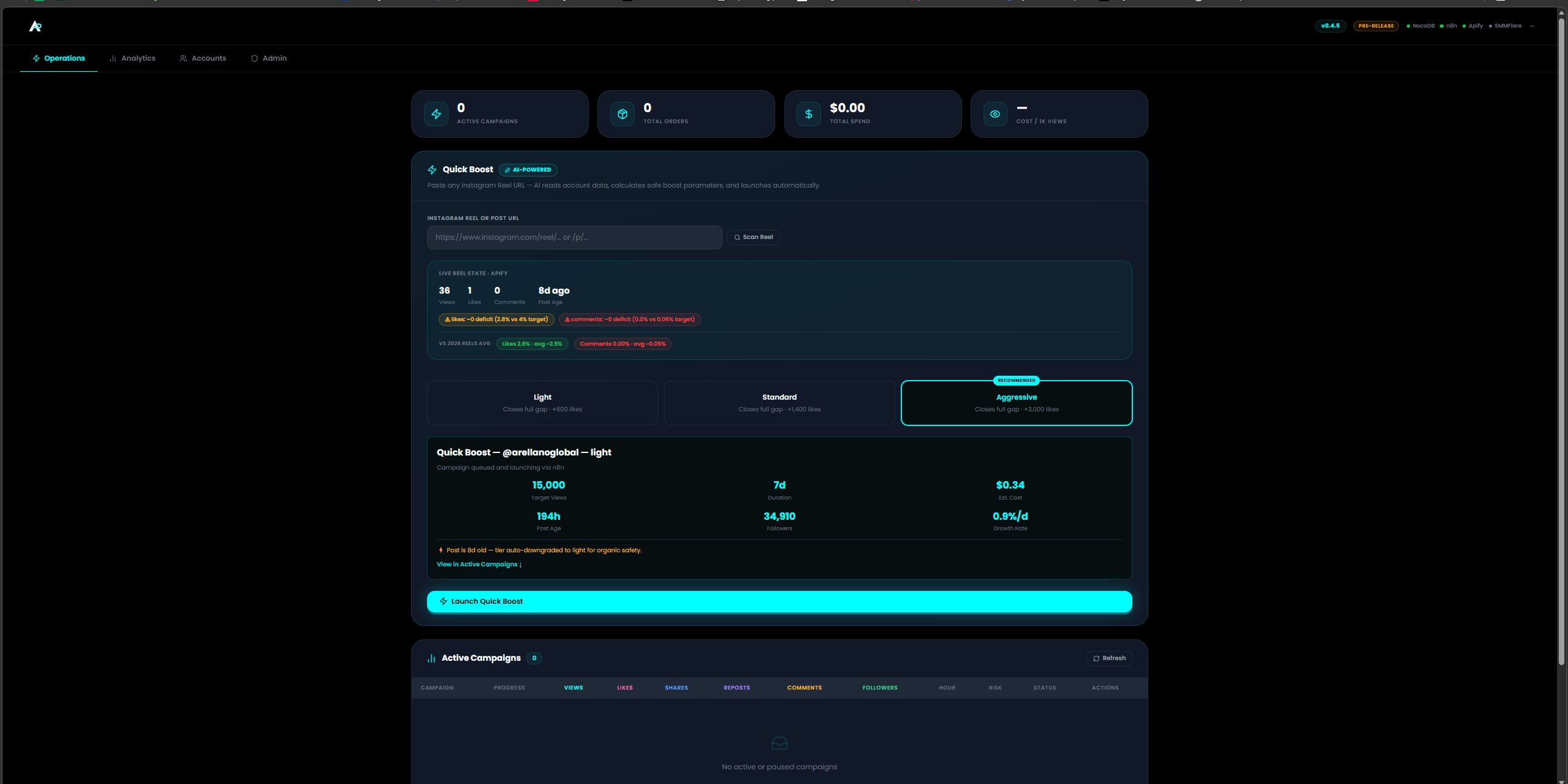
SMM DRIP — CAMPAIGN OVERVIEW DASHBOARD
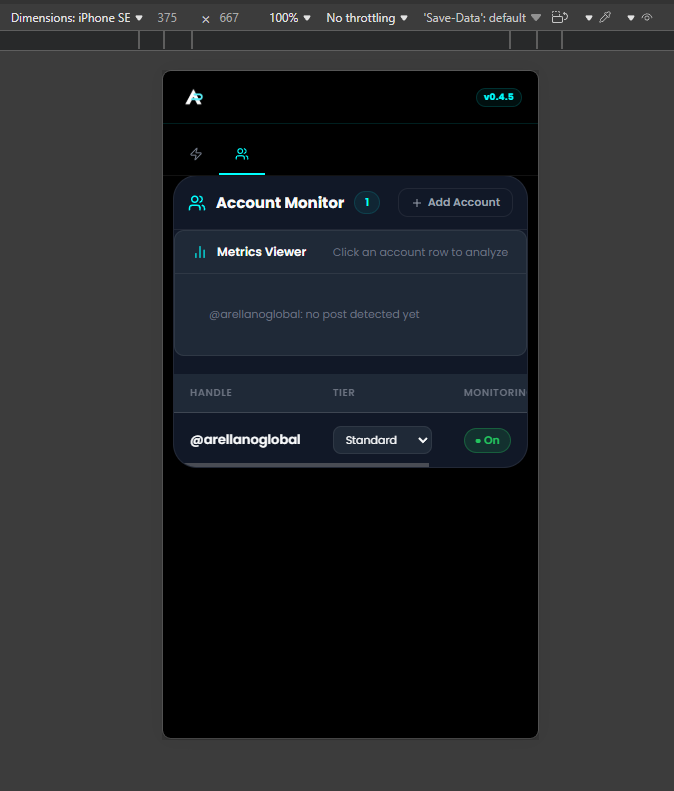
CAMPAIGN CONTROLS
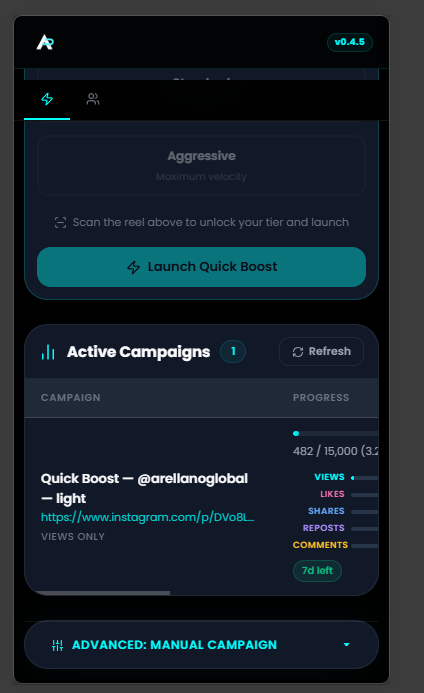
PHASE-GATE WORKFLOW VIEW
A proprietary Instagram engagement automation system built on deficit-based phase-gated drip algorithms — delivering growth in the exact ratios the platform expects, autonomously, across 20+ live campaigns.
A growth-stage brand operating across multiple Instagram presences faced a compounding problem: manual social media management produced engagement that looked exactly like what it was — inorganic. Likes arriving in batches. Comments clustered in a single hour. Views spiking, then flatline for days.
Instagram's algorithm is trained to detect precisely this pattern. When engagement ratios fall outside the statistical envelope of organic behavior, the platform suppresses reach — the content enters a low-distribution state that manual intervention cannot recover. The harder the team pushed, the worse the suppression became.
Beyond algorithmic risk, the operational overhead was unsustainable. A human operator was required to fire each campaign phase, monitor ratios, judge when to move from views to engagement, and decide when comments were safe to deploy. Every post demanded 3–4 manual interventions across a 24-hour window — a model that could not scale past a handful of simultaneous campaigns.
The brief was clear: eliminate human gates entirely while making the delivery pattern statistically indistinguishable from a real post gaining organic traction.
The solution replaces every manual decision point with a deterministic state machine. Twelve n8n workflows orchestrate delivery across four time-gated phases, each workflow reading live post metrics before calculating how much engagement to inject — never more, never less than organic ranges allow.
n8n v2.10.4 self-hosted. 12 workflows across campaign lifecycle. Cron + webhook triggers. Zero human gates in steady-state.
NocoDB as campaign state store. Each row tracks post ID, phase status, delivered counts per metric, deficit carry-forward, and timestamps.
Apify Instagram Scraper for live post metric reads. Profile-scraper (256 MB) preferred over post-scraper (512 MB) for 4× cost reduction.
SMMFlare API executes all engagement delivery. Receives exact calculated quantities per metric — no rounding, no padding beyond ratios.
Vanilla HTML/JS/CSS — zero build step. Chart.js v4.4.0 for live campaign metrics. Mobile-first at 768px/640px/400px breakpoints.
Keycloak 26 OIDC with PKCE S256 flow. Dashboard access requires authenticated session — no bypass path, no shared credentials.
A single-page operator dashboard surfaces all 20+ active campaigns, per-metric delivery progress, workflow health status, and real-time ratio compliance indicators. Built with zero build tooling — pure HTML, CSS, and Chart.js.
Dashboard UI — campaign cards, ratio health gauges, workflow status tiles, and 7-day delivery chart. Vanilla HTML/JS, zero build step.
Each workflow owns a single responsibility. No workflow assumes another has completed. All state transitions are checked against NocoDB before any delivery call is made to the API. The full campaign lifecycle from post detection to final comment deployment runs without a single human touchpoint.
Accepts a post URL and target parameters. Validates the post exists via Apify pre-scan, creates the NocoDB campaign row with phase status PENDING, and queues the post for WF-1. The only human touchpoint in the entire system.
NocoDB write · Apify validateDelivers views in an exponential curve that mimics organic viral spread. Reads the current view count, calculates the remaining deficit against the target, and fires a calibrated batch. Never delivers the full target in one shot — curve shaping is the core of Phase 1.
Apify read · SMMFlare deliver · deficit calcPolls the current view count, calculates 4% as the like target, reads actual current likes from Apify, and delivers the deficit only — the difference between target and actual. Kill switch at 5%: if the ratio would breach the threshold, delivery halts.
ratio check · deficit delivery · kill switchIdentical deficit pattern to WF-2 but targeting share count. Shares at 3% of views are at the high end of natural distributions — the kill threshold at 4% provides a safety margin before the algorithm detects amplification behavior.
6h time gate · deficit only · ratio guardReposts and saves are the lowest-ratio metrics but among the most powerful signals for distribution. WF-5 targets 0.5% reposts; WF-11 targets 0.2% saves. Both operate on deficit logic with 6-hour phase gates, never firing ahead of the engagement window.
Phase 3 parallel deliveryThe only metric not expressed as a ratio. WF-6 receives an absolute follower target per campaign and delivers to deficit. Followers are independent of view counts — organic follow rates vary too widely across account types to use ratio enforcement.
absolute target · deficit deliveryComments are the most algorithmically sensitive metric. A comment velocity that doesn't match the account's post age and view count is a strong suppression signal. WF-7 enforces a hard 24-hour gate before any comment delivery, then applies the 0.06% ratio. Kill threshold at 0.10% — zero tolerance.
24h gate · strictest ratio · zero bypassPolling worker that runs on a schedule and refreshes the live metric snapshot for all active campaigns in NocoDB. Other workflows read from this cache rather than hitting Apify directly on every execution — reducing API credit consumption by batching reads.
Apify batch read · NocoDB state updateWF-9 is the quick-boost pre-scanner: runs Apify before any boost fires to confirm the post is still accessible and metrics are fresh. WF-10A is the pending boost firer: polls NocoDB for campaigns in BOOST_PENDING state and fires them. WF-10B is the daily autonomous scanner: checks all monitored accounts for new posts and auto-creates campaigns — the system self-feeds.
WF-10B fully autonomous · no operator inputEvery delivery decision is derived from a single question: what does this post's current metric count need to reach a ratio indistinguishable from organic growth? The answer is a precise deficit — never an estimate, never a padding buffer.
| Metric | Basis | Target Ratio | Kill Threshold | Phase Gate | Workflow |
|---|---|---|---|---|---|
| Views | Absolute target | Campaign param | — | Phase 1 · 0h | WF-1 |
| Likes | % of views | 4.0% | >5.0% STOP | Phase 3 · 6h | WF-2 |
| Shares | % of views | 3.0% | >4.0% STOP | Phase 3 · 6h | WF-3 |
| Reposts | % of views | 0.5% | — | Phase 3 · 6h | WF-5 |
| Followers | Absolute target | Campaign param | — | Phase 3 · 6h | WF-6 |
| Comments | % of views | 0.06% | >0.10% STOP | Phase 4 · 24h | WF-7 |
| Saves | % of views | 0.2% | — | Phase 3 · 6h | WF-11 |
Every ratio-based workflow follows the same three-step calculation before firing: (1) Read the current live metric count via Apify. (2) Compute the target count as views × ratio. (3) Deliver the delta: target − actual = deficit.
If the deficit is zero or negative (organic engagement already met the target), the workflow exits without calling the delivery API. If the ratio check shows a current ratio above the kill threshold, the workflow writes a RATIO_KILL event to NocoDB, skips delivery, and alerts the operator dashboard. No manual intervention is required or expected.
The source: 'backfill' flag on WF-9 quick boosts bypasses the 72-hour upper age gate (stale post protection) while keeping the 6-hour minimum gate fully enforced. This allows deficit recovery on posts that have aged past the normal campaign window.
A fully autonomous engagement engine running 24/7 across 20+ live campaigns, delivering every metric within organic ratio bounds, with zero operator touchpoints after initial campaign creation.
WF-10B runs on a daily cron, scans all monitored Instagram accounts for new posts using Apify, and automatically creates campaigns in NocoDB for any post not already in the system. From post detection through views delivery, engagement delivery, and final comment deployment — the entire 24-hour lifecycle completes with zero human gates. Operators see results in the dashboard; they are never in the critical path.
Early prototypes used the Apify post-scraper (512 MB actor) for all metric reads. Switching metric refreshes to the profile-scraper (256 MB actor) where post-level data was not required reduced Apify compute unit consumption by 4× per read cycle — a direct infrastructure cost reduction at scale.
The operator dashboard is vanilla HTML, CSS, and JavaScript with Chart.js v4.4.0 imported from CDN. No bundler, no framework, no compilation step. Deployment is a single file copy. Mobile-first breakpoints at 768px, 640px, and 400px keep the dashboard fully operational on a phone in the field.
Keycloak 26 with PKCE S256 flow protects the dashboard. No shared passwords, no API key in the URL. Operator sessions expire and require re-authentication. The auth layer is fully decoupled from the campaign logic — dashboard access can be revoked without touching a single workflow.
I build proprietary automation infrastructure — from workflow engines to full-stack dashboards. If you need something built right, let's talk.
Get In Touch →SMM Drip Engine control dashboard — 20+ active campaigns, fully autonomous.
SMM DRIP — CAMPAIGN OVERVIEW DASHBOARD
CAMPAIGN CONTROLS
PHASE-GATE WORKFLOW VIEW